 Tech-Jutsu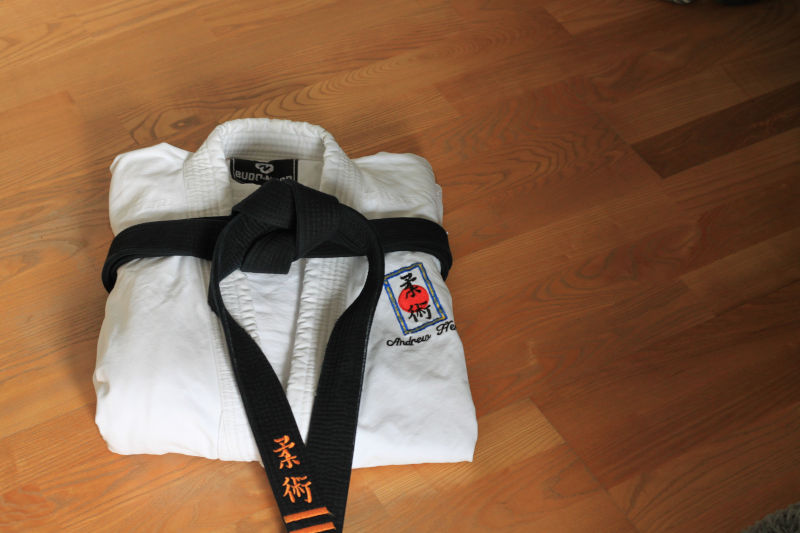
Or, to be more precise a keikogi, which translates to “training clothes”, because ‘gi’ on it’s own, simply means clothes.
Why do we wear a keikogi in Ju-jutsu, Judo, Karate when MMA and BJJ No-Gi grappling, to take a couple of examples, have both contributed to changing perceptions, with popular opinion moving away from keikogi? This trend seems to shift away from tradition and conformity towards individualism, personal style and an unneccessary focus on physique as an indicator of ability. This is not to say that BJJ No-Gi is not the correct way or that lack of keikogi in MMA is detrimental to the sport, because in those sports there is a reason: Competetive MMA is not about grappling primarily but on domination, where the gi is unneccesary for that goal, and BJJ No-Gi competition is a complement to the gi-based grappling rules.
Whilst these sports may promote a move away from wearing keikogi, I see a number of reasons for continuing to promote awareness about why we who train Japanese martial arts especially, wear a keikogi. I do not believe that No-Gi lycra and the complete ommission of an uwagi (jacket) has a place in those arts. However, you may be wondering at this point “why do we have to bring this up?”, and the answer is that modern day sports have, of course, an impact on social perceptions. Within a Ju-jutsu school, there may be beginners and even some veterans who have a desire to shift away from keikogi because in their eyes, it has no ‘coolness factor’ or they may feel more attuned to current trends with lycra sportswear and wish to eschew traditional training clothes. I believe this sets an uncomfortable precedence, as there are sound and practical reasons for standard uniforms:
The fabric is very durable. It will be very hard to tear or otherwise damage compared to standard modern clothes, and will last for years. It allows many grappling techniques, and rough and tumble techniques to be performed without damaging every-day clothing, which allow us, particularly in Ju-jutsu & Judo, to simulate some sort of clothing that a would-be-attacker would in all liklihood be wearing (it’s probably unlikely to be attacked by someone wearing Speedos, but the statistics would be interesting). This was the primary reason for Jigoro Kano incorporating a keikogi into Judo so that his students would not wear out their silk (or cotton) kimonos, which, due to the expense of those fabrics, were a valuable commodity in Japan at that time, and often needed to be borrowed from family elders for Judo training, to the elders consternation [source: In the dojo, by David Lowry].
Wearing a standard uniform puts you in a certain frame of mind. Just like a policemans uniform or a firemans uniform, once donned, puts them in a certain frame of mind (they tend to “switch” into job mode instantly upon putting on the uniform). Donning a keikogi puts you in the right frame of mind for training. You leave your job, family life and daily troubles at the door, and you become subconciously prepared for the physical exertion of martial arts training, and for the training rules of the dojo that are there for practical safety, as much as they are there for tradition.
A training uniform is an effective ‘equaliser’ of students: A highly successful CEO, an ambitious middle-manager, a school teacher, a janitor, an engineer, a nurse, a gardener and a cleaner working in a temp job, all come to class in their daily attire, which is an indicator to everyone of their status in life. All that changes when they get into their training clothes. They discard their expensive watches, fine clothes, or physical labour attire, and step onto the mat as equals. The only way to distinguish them is by their grade; a symbol of their competency, knowledge and experience in this art. And that is my number one reason for wearing a keikogi, because it brings us all down to earth, and reminds us that when you take away everything else, we’re all the same underneath, and on that level playing field, you start to see people for who they are rather than what they do, or how much power and status they have.